Find a stop on the map
Imperial Palace East Gardens in Tokyo
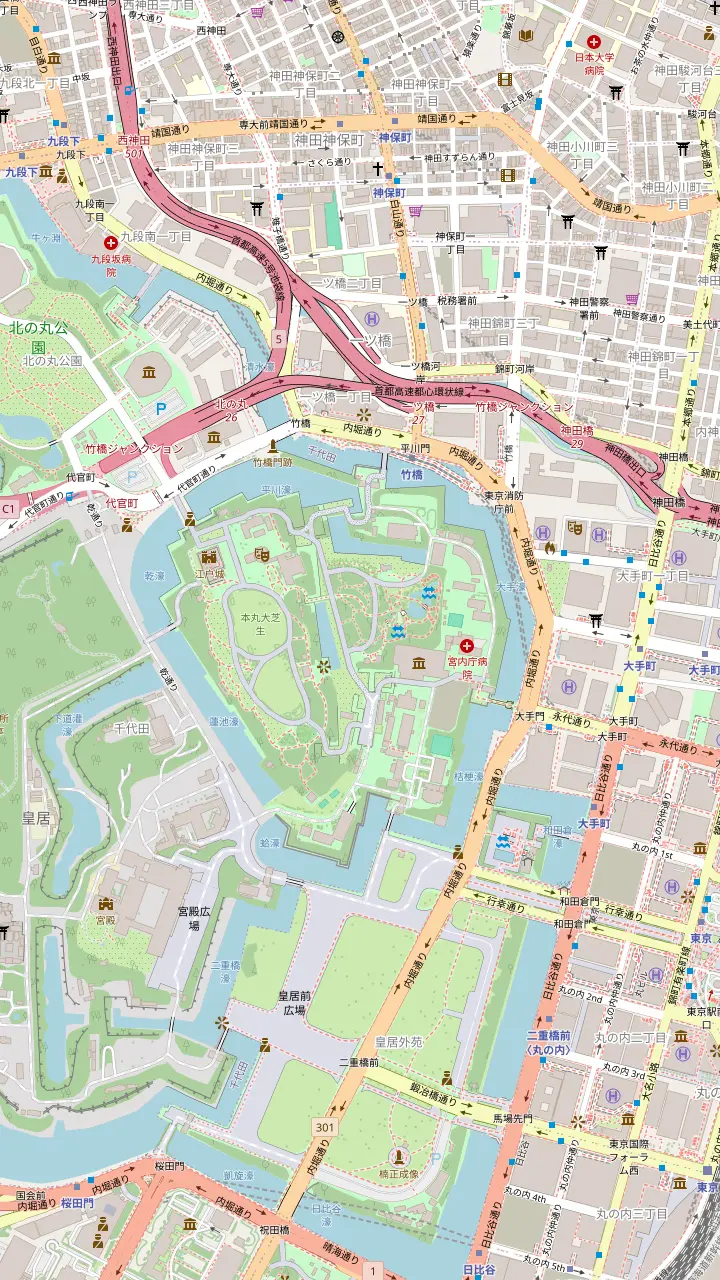
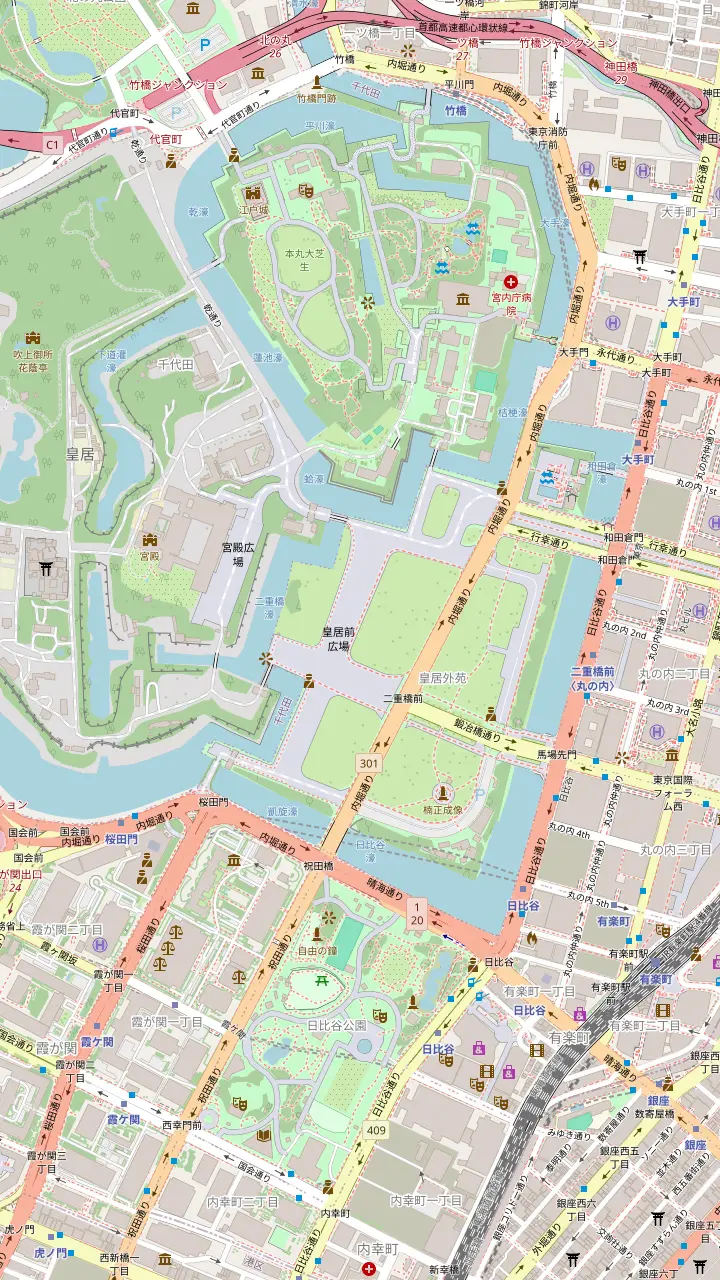
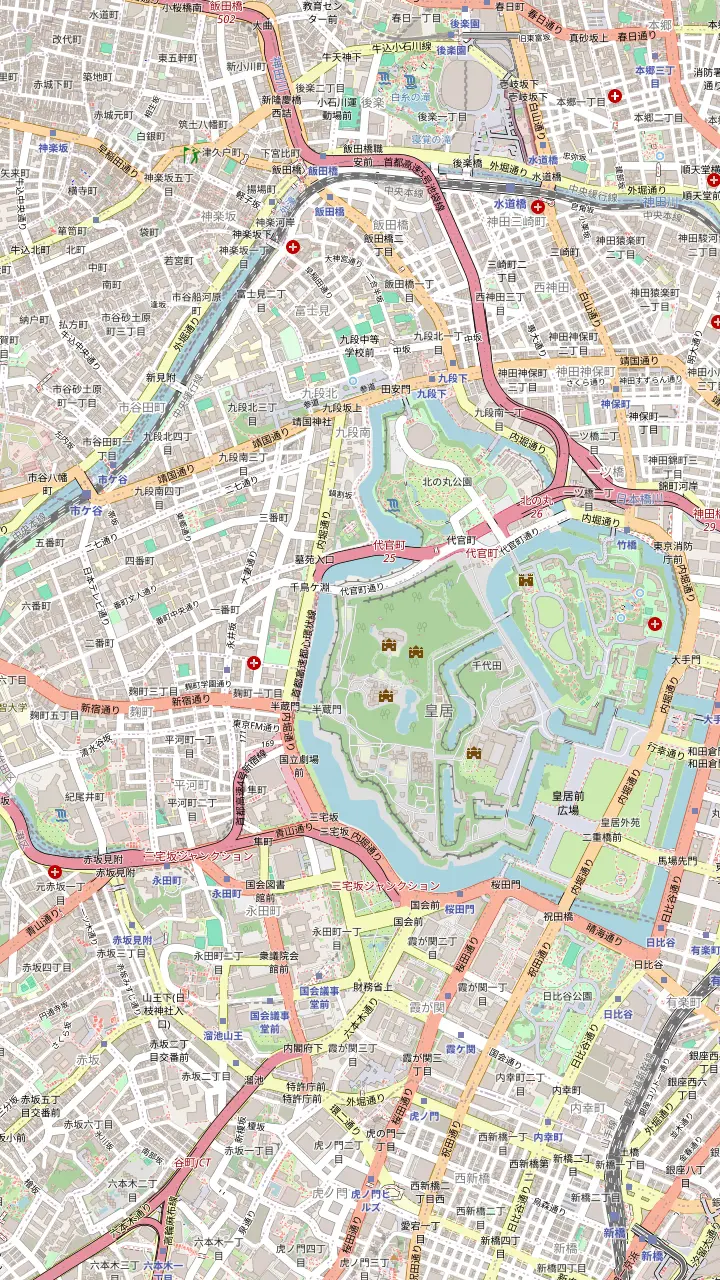
Map of 21 stops
The gardens, the plaza and the loop, pin by pin
Pick a route and tap a pin or a stop: you get its note and a Google Maps link.
The old main gate of Edo Castle and the usual way into the East Gardens.
Google MapsEntrance to the Sannomaru Shozokan is free.
Google MapsOne of the numbered points on the agency's East Gardens map.
Google MapsThe stone base of the castle tower is 11 meters high.
Google MapsA three-storied keep 16 meters tall, in the south of the ruins.
Google MapsA 5-minute walk from Takebashi Station, exit 1a.
Google MapsThe third public gate of the East Gardens.
Google Maps
Completed around 1620, the largest remaining gate of Edo Castle.
Google MapsOfficially, Nijubashi means the iron bridge only, not the two bridges together.
Google MapsThe bronze statue was presented to the Imperial Household Agency in 1900.
Google MapsThe backdrop for photos taken from the glass bridge in Wadakura Fountain Park.
Google MapsBuilt in 1961 to mark the wedding of the Heisei Emperor Emeritus.
Google MapsA 2-minute walk from exits 2 and 6 to Kokyo Gaien.
Google Maps
Home to one of the runner stations with rental lockers and showers.
Google MapsAbout 140 cherry trees line the 700-meter walkway.
Google MapsA 5-minute walk from exit 2 to the moat.
Google MapsA 5-minute walk from exit 1a to Hirakawa-mon.
Google MapsA 2-minute walk to the Nijubashi on the plaza side.
Google MapsRunner station with lockers and showers at this stop.
Google MapsA runner station stands beside this station.
Google MapsThe 1964 Olympic arena for martial arts, in Kitanomaru.
Google Maps
Map © OpenStreetMap contributors
The one part of the palace grounds anyone can walk into without a booking. Here are the hours, the three gates, the keep base, the tower and the flowers worth timing a visit around.
Editorial team, tokyoimperialpalace.top · Updated November 6, 2026 · ~6 min read
Overview
What the East Gardens actually are
The East Gardens were laid out as an attached garden of the palace, using parts of the former Honmaru, Ninomaru and Sannomaru of Edo Castle, and they have been open to the public since 1968.7 So the lawns are not a park built on empty land. You are standing inside the old castle's inner compounds, where the shogun's court once sat.
The size is easy to underestimate on a map. The grounds cover 210,000 square meters,6 and the agency's own map numbers 28 points to find, from the Fujimi-yagura tower to the Imperial Palace Visitor Center.8 Most of it is gravel path, wide grass and stone wall, so the walk feels calm rather than packed with attractions.
Think of it as the easy way into the history of the site. The Imperial Household Agency describes wide lawns, old stone walls from the former castle and yagura watchtowers, with cherry blossoms in spring, irises in summer, autumn leaves in fall and snowy scenes in winter.9 You do not need a guide to enjoy it, though a guide adds names to the stones, and the paths are flat enough for an unhurried visit at any pace. Allow a relaxed morning or afternoon rather than a quick detour from the station.
Pick a gate
The three gates side by side
| Gate | Nearest station | Walk | Note |
|---|---|---|---|
| Ote-mon | Otemachi, exit C13a | 5 minutes5 | Old main gate of Edo Castle10 |
| Hirakawa-mon | Takebashi, exit 1a | 5 minutes22 | One of the three public gates4 |
| Kitahanebashi-mon | Beyond Hirakawa moat | See the agency map | One of the three public gates4 |
Walking times are those given by the Chiyoda City Tourism Association for the garden as a whole.5,22
Hours by season and the days it is shut
The closing time moves through the year, and that is the detail that catches visitors out. From March 1 to April 14 the gardens run from 9:00 to 17:00, with the last entry at 16:30.17 From April 15 to August 31 they stay open until 18:00, last entry 17:30.18
September goes back to 17:00,19 October shortens to 16:30 with the last entry at 16:00,20 and from November 1 to the end of February the gardens close at 16:00, last entry 15:30.21 In winter, then, plan to arrive in the morning, because the light and the gate both go early.
Closed days are just as important. The gardens shut every Monday and Friday, yet they open on national holidays other than the Emperor's Birthday on February 23.2 They are also closed from December 28 to January 3.3 The agency may close them for court functions too, so check its calendar before you travel on an unusual date. A Monday visit that fails is a common mistake, and the Friday closure surprises people who assume the weekend rule applies.
Which gate to enter by
There are three entrance and exit gates: Ote-mon, Hirakawa-mon and Kitahanebashi-mon.4 Ote-mon is the grand one. It served as the main gate of Edo Castle and was the gate used by feudal lords who came to stay in the castle under the alternating attendance system.10
For most visitors Ote-mon is also the practical choice. It is a 5-minute walk from Otemachi Station, exit C13a,5 and from Tokyo Station you need about 15 minutes on foot from the Marunouchi North Gate.24 Hirakawa-mon faces Takebashi Station, where exit 1a is also a 5-minute walk.22
Baggage is inspected at the entrance, and the agency suggests leaving bags in a locker at a station or hotel.25 When Inui Street is open in spring or autumn, the rules change: you can enter by Hirakawa-mon or Kitahanebashi-mon only, and Ote-mon becomes exit only.26
Match your visit
What kind of East Gardens visit are you?
Match a row to your time and mood
If I want a free stroll with no booking
Walk in by Ote-mon
Admission is free, and Ote-mon is a 5-minute walk from Otemachi.1,5
If I want the story behind the stones
Take a guided walk
The Viator tour here lasts 2 hours with a group of up to 15.
If I only have a winter afternoon
Arrive before 15:30
From November to February the last entry is 15:30.21
If I am visiting on a Monday or Friday
Plan another day
The gardens are closed every Monday and Friday.2
If I love flowers
Time it for blossom
The calendar puts cherry trees at mid-March to early April.23
A walk through the old castle grounds
After Ote-mon, the Museum of the Imperial Collections, Sannomaru Shozokan, is on your left. Entrance is free, and inside are paintings, books and craft items passed down in the Imperial Family.11 The museum and the Visitor Center beside it also cover the history of the family and the palace.40
Next come the guardhouses. Three remain in the gardens: Doshin-bansho, Hyakunin-bansho and O-bansho.12 Lower-ranking samurai stood guard at Doshin-bansho, the one closest to the gate.41 They worked as security checkpoints on the way into the castle, so the order of the buildings tells you how far a visitor was trusted. Read the line of guardhouses as a security system laid out in stone, with the least senior guards posted nearest the street.
Beyond them lies the Ninomaru Garden, a strolling garden restored from designs by the Edo period designer Kobori Enshu.13 Near the Honmaru rest area there is a restoration miniature of the castle, which helps a great deal in picturing what the empty lawns once held.14
Price a guided walk
What a guided East Gardens walk costs for your group
Enter your party size and read off three starting prices
Compare all 3 options
What a guided East Gardens walk costs for your group
Enter your party size and read off three starting prices
- Shogun walking tour2 hours, small group · per individual from $13
≈
View - East Gardens walk2.5 hours · per individual from $20
≈
View - Private tour2 hours, private · from $63 up
≈
View
From-prices on GetYourGuide, shown at the ECB reference rate. Your exact price is confirmed during booking.
A walk in order
From Ote-mon to the keep base
Enter
Ote-mon Gate
The old main gate of Edo Castle is the usual way in.10
Just inside
Sannomaru museum
Free entrance to imperial collections.11
Along the path
Guardhouses
Doshin-bansho is nearest the gate; Hyakunin-bansho and O-bansho lie deeper.12
Mid-garden
Ninomaru Garden
A strolling garden restored from Kobori Enshu's designs.13
Rest stop
Edo Castle miniature
The model is at the annex of the Honmaru rest area.14
Last
Tenshudai
The keep base and the tower that survived
The main reason many people come is the Tenshudai. It supported the castle tower, which was 51 meters high and is said to have been the tallest in the country.42 The stone base that remains is 11 meters high, 41 meters from east to west and 45 meters from north to south.15
You can climb to the top and look out over the lawns.16 The tower itself was destroyed by fire in 1657,43 and its story, and why it was never rebuilt, is told in full on the Edo Castle page here.
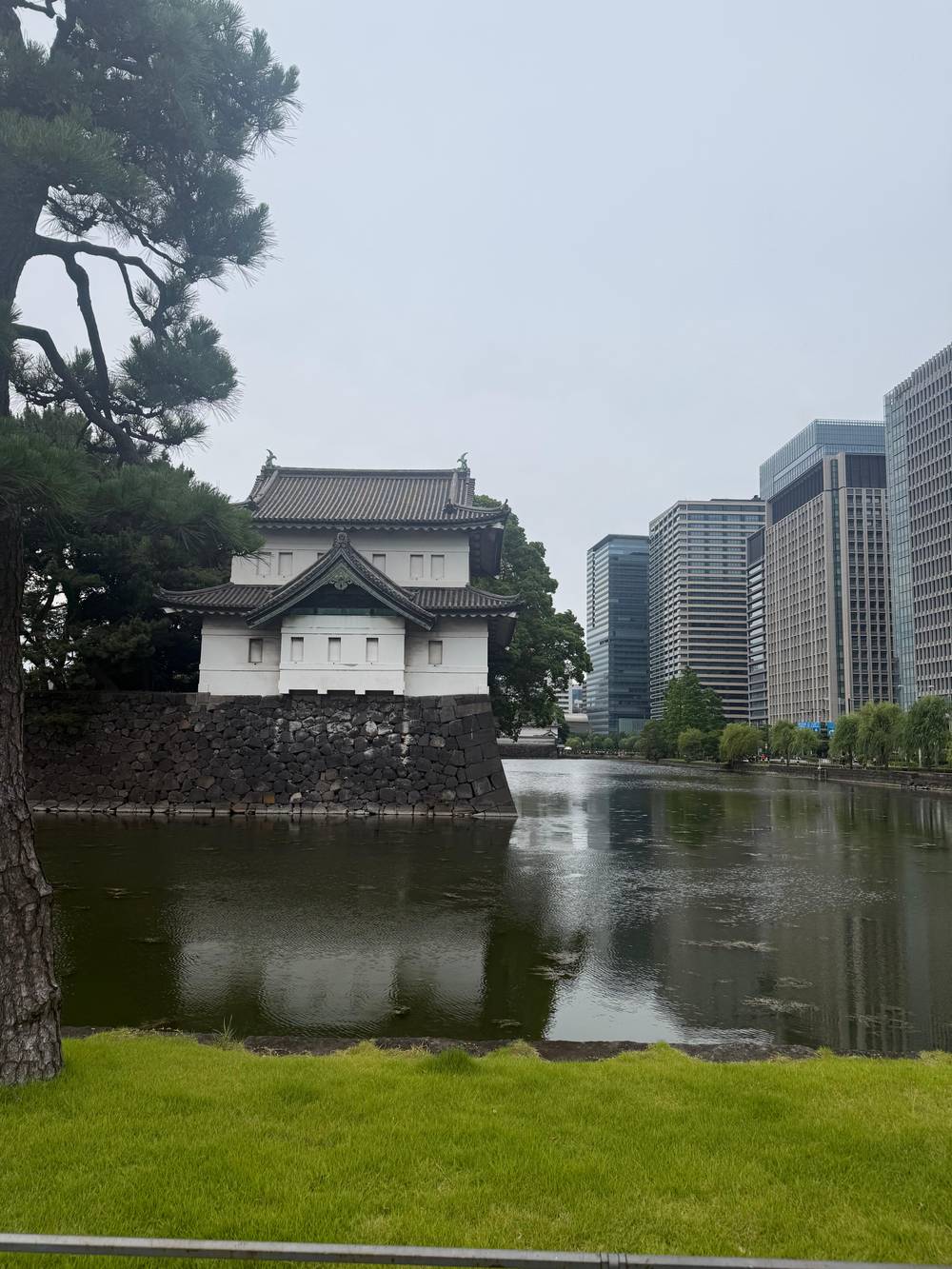
The building you can still see is the Fujimi-yagura, a three-storied keep 16 meters tall in the south of the ruins.27 It is described as the only three-storied keep that is a historic landmark of Edo Castle.44 An open area built in front of it in November 2016 lets you approach for a closer look.45
Video
Tokyo Imperial Palace: complete walking guide from Tokyo Station
Tokyo trip Walker on YouTube · Your tap on play is what loads the video.
cherry blossoms in spring, irises in summer, autumn leaves in fall, and snowy scenes in winter
Before you walk in
East Gardens checklist
Timing3
Flowers worth timing a visit around
The agency publishes a flower calendar for the gardens, and the cherry trees appear in several groups. One group has its good time to see from early February to early March,46 the main group from mid-March to early April,23 and a later group from mid-April to late April.47
That spread means the gardens can still show blossom after the famous moat-side display has gone. For a fuller look at the sakura around the palace, see the cherry blossoms page on this site. Autumn brings Jugatsuzakura cherries, which sit in the autumn list of the calendar.48
Plan hours around the season too. In the cooler months the gardens close at 16:00,21 and from mid-April they stay open longer,18 so a spring evening gives more time among the lawns than a November afternoon. Visitors who want the gardens in good light should keep a flexible day in the plan instead of committing to a fixed slot.
On your own, or with a guide beside you
On your own, you need only a free audio guide app, which the agency provides for the East Gardens.39 Add the printed map and the numbered points and the visit is straightforward. The weak point is context, because the stones, gates and low walls carry the history but do not explain it. Without a name beside each ruin, the lawns can look like an ordinary park, and the story behind the castle stays hidden.
A guided walk fills that gap. The Viator walking tour behind this site lasts 2 hours, caps its group at 15 and starts from $13, and can be cancelled free of charge until 24 hours before. Its listing mentions stone gates, remnants of castle walls, the keep foundation and the Ninomaru Garden.
Another listing, a GetYourGuide East Gardens walk, runs for 2.5 hours and is priced from $20. A private version of the East Gardens and Edo Castle tour starts from $63 for a 2-hour private group tour, and the listing does not say whether that is per person or per group. The calculator above lets you set group size and compare them.
FAQ
Common questions, answered fast.
Is the Imperial Palace East Gardens free?
Admission is free.1
Which days are the East Gardens closed?
What time do the East Gardens close?
How do I get to the East Gardens?
Can I climb the old keep base?
The Tenshudai is open to climb for the view.16
Do I need a ticket for the museum?
Entrance to the Sannomaru Shozokan is free.11
How big are the East Gardens?
That is the figure given by the Chiyoda City Tourism Association.6
Is baggage checked?
The agency suggests leaving luggage in a locker at a station or hotel.25
Sources
- Imperial Household Agency · The East Gardens of the Imperial Palace in Tokyo ↩
- Imperial Household Agency · The East Gardens of the Imperial Palace in Tokyo ↩
- Imperial Household Agency · The East Gardens of the Imperial Palace in Tokyo ↩
- Imperial Household Agency · The East Gardens of the Imperial Palace in Tokyo ↩
- Chiyoda City Tourism Association · The East Gardens of the Imperial Palace ↩
- Chiyoda City Tourism Association · The East Gardens of the Imperial Palace ↩
- Imperial Household Agency · The East Gardens of the Imperial Palace in Tokyo ↩
- Imperial Household Agency · The East Gardens of the Imperial Palace in Tokyo ↩
- Imperial Household Agency · The Imperial Palace (Kids page) ↩
- Chiyoda City Tourism Association · The East Gardens of the Imperial Palace ↩
- Chiyoda City Tourism Association · The East Gardens of the Imperial Palace ↩
- Chiyoda City Tourism Association · The East Gardens of the Imperial Palace ↩
- Chiyoda City Tourism Association · The East Gardens of the Imperial Palace ↩
- Chiyoda City Tourism Association · The East Gardens of the Imperial Palace ↩
- Chiyoda City Tourism Association · The East Gardens of the Imperial Palace ↩
- Chiyoda City Tourism Association · The East Gardens of the Imperial Palace ↩
- Imperial Household Agency · The East Gardens of the Imperial Palace in Tokyo ↩
- Imperial Household Agency · The East Gardens of the Imperial Palace in Tokyo ↩
- Imperial Household Agency · The East Gardens of the Imperial Palace in Tokyo ↩
- Imperial Household Agency · The East Gardens of the Imperial Palace in Tokyo ↩
- Imperial Household Agency · The East Gardens of the Imperial Palace in Tokyo ↩
- Chiyoda City Tourism Association · The East Gardens of the Imperial Palace ↩
- Imperial Household Agency · Flower Calendar ↩
- Chiyoda City Tourism Association · The East Gardens of the Imperial Palace ↩
- Imperial Household Agency · The East Gardens of the Imperial Palace in Tokyo ↩
- Imperial Household Agency · Visit of the General Public to Inui Street in the Imperial Palace ↩
- Chiyoda City Tourism Association · The East Gardens of the Imperial Palace ↩
- Ministry of the Environment (Kokyo Gaien National Garden) · Sakuradamon Gate
- Ministry of the Environment (Kokyo Gaien National Garden) · The Main Gate and the Nijubashi Double Bridge
- Ministry of the Environment (Kokyo Gaien National Garden) · Statue of Kusunoki Masashige
- Ministry of the Environment (Kokyo Gaien National Garden) · Wadakura Fountain Park
- Ministry of the Environment (Kokyo Gaien National Garden) · Wadakura Fountain Park
- Chiyoda City Tourism Association · Kokyo Gaien National Garden
- Tokyo Convention & Visitors Bureau (GO TOKYO) · Running Course Guide for Runners
- Ministry of the Environment (Kokyo Gaien National Garden) · Chidorigafuchi Moat
- Tokyo Convention & Visitors Bureau (GO TOKYO) · Chidori-ga-fuchi Moat
- Chiyoda City Tourism Association · Nijubashi Bridge
- Ministry of the Environment (Kokyo Gaien National Garden) · Running (marathon) use of Kokyo Gaien (Japanese page)
- Imperial Household Agency · The East Gardens of the Imperial Palace in Tokyo ↩
- Imperial Household Agency · The East Gardens of the Imperial Palace in Tokyo ↩
- Chiyoda City Tourism Association · The East Gardens of the Imperial Palace ↩
- Chiyoda City Tourism Association · The East Gardens of the Imperial Palace ↩
- Chiyoda City Tourism Association · Tenshudai ↩
- Chiyoda City Tourism Association · The East Gardens of the Imperial Palace ↩
- Chiyoda City Tourism Association · The East Gardens of the Imperial Palace ↩
- Imperial Household Agency · Flower Calendar ↩
- Imperial Household Agency · Flower Calendar ↩
- Imperial Household Agency · Flower Calendar ↩
More to read