Dynamic chart
Imperial Palace plaza in Tokyo and the Nijubashi bridge
The plaza through the year
Twelve months at the Nijubashi plaza
Choose a month to compare sunset, day length and the usual warmth, plus what the plaza offers then.
Sunset
Jan
- Sun sets around 16:49
- Sun is up about 10 h29
- What the month brings: Main Gate opens on January 24
- Days hover near 10°C, nights hover near 2°C29
The Main Gate to the palace is open to the public on January 2.1
Feb
- Sun sets around 17:21
- Sun is up about 10.9 h29
- What the month brings: Warm orange lights at dusk4
- Days hover near 10°C, nights hover near 2°C29
The Main Gate also opens for the Emperor's Birthday.1
Mar
- Sun sets around 17:48
- Sun is up about 11.9 h29
- What the month brings: Soft white lights at dusk4
- Days hover near 13°C, nights hover near 5°C29
In spring the lights are a soft white color.4
Apr
May
Jun
Jul
Aug
Sep
- Sun sets around 17:50
- Sun is up about 12.5 h29
- What the month brings: Warm orange lights at dusk4
- Days hover near 27°C, nights hover near 20°C29
In autumn the lights change to a warmer, orange tone.4
Oct
Nov
Dec
Sunset is worked out for the 15th of each month on Japan time. Day length and temperatures: NOAA averages for the Tokyo station used for this site, 1971 to 2020.
The Imperial Palace plaza in Tokyo gives the most photographed view of the palace, taken across two bridges. Learn which bridge carries the name, what stands around it and the best times for the plaza's lights.
Editorial team, tokyoimperialpalace.top · Updated November 6, 2026 · ~6 min read
Overview
- Which bridgeNijubashi officially means the iron bridge only, not the two bridges together.1
- Can you cross it?Both bridges are usually closed to the public.2
- PinesAbout 2,000 Japanese black pines stand on the plaza.3
- LightsThe lights go on 15 minutes after sunset and are turned off by 9 p.m.4
- Nearest stationA 2-minute walk from Sakuradamon Station.5
Which bridge is the Nijubashi?
Most photographs of the palace show two bridges, and visitors tend to treat the pair as one monument. The Ministry of the Environment is precise on the point: the Nijubashi Double Bridge refers to the iron bridge, not to the two bridges.1 The stone bridge in the foreground has its own name, Seimon-ishibashi, and tour guides tend to correct the common mix-up gently. Knowing the difference earns a quiet nod from a local.
That stone bridge is made of granite and was designed in a Western architecture style.6 Behind it stands the iron bridge, which also goes by the names Ninohashi and Tsukimihashi.7
The two bridges are used for official events and foreign guests, but are usually closed to the public.2 So when you stand at the edge of the plaza you are looking at a working approach to the palace and not a monument turned into a footpath. Photographs are taken from the plaza side, and the view loses nothing from the distance.
On the plaza
Four things to find in the outer garden
| Feature | What it is | Fact | Evening lit |
|---|---|---|---|
| Black pines | Sculptural trees on the plaza | About 2,0003 | No |
| Kusunoki statue | Bronze samurai on horseback | Presented 190010 | Yes14 |
| Sakuradamon | Largest remaining Edo Castle gate | Built around 162015 | Yes14 |
| Wadakura bridge | Arched bridge by the fountain park | Fountain park opened 196116 | Yes14 |
The Ministry of the Environment lists which features are lit at night.14
Why a bridge is called double
The nickname has a structural explanation. In the Edo period, because of its height above the moat, the Nijubashi was a wooden bridge reinforced underneath by a further wooden bridge, hence the name.8 The doubling was literal.
The wooden bridge gave way to metal in the Meiji period. It became an iron bridge in 1888 and was repaired in 1964 to reach its present appearance.9 The date is a useful marker if you wonder why a bridge that looks so old feels so tidy.
The height of the bridge above the moat was the reason for the second layer of timber. Anyone interested in the engineering can read the full story on the Ministry's site, and a guide on the ground will show the iron frame and talk through the repair work.
The famous view and when you can cross
The most popular portrayal of the Imperial Palace is the view of the Stone Bridge with the Main Gate on the left, the Iron Double Bridge behind it and the Fushimi watchtower in the distance.17 You take it from the edge of the plaza, and no ticket is needed.
Crossing is another matter. The Main Gate to the palace is open to the public on January 2 and for the Emperor's Birthday.11 The agency's palace tour crosses the Nijubashi as well, which GO TOKYO calls a symbol of the palace and even of Tokyo.18
If neither option fits your dates, the plaza view still repays the stop. The walk is short, and the guidance on the special openings page tells you when the bridge becomes a path. Early arrival helps on those days, as long lines form for entry. Read the agency's notice for the exact hours before you set out, and wear shoes that cope with gravel and slopes.
Your plaza visit
When should you come?
Rows for the hour and the photograph you want
If I want the classic photograph
Stand at the plaza edge
The famous view shows the Stone Bridge, the Main Gate and the Iron Bridge behind it.17
If I want to cross the bridge
Come on January 2
The Main Gate opens then and on the Emperor's Birthday.11
If I want lights and quiet
Come at dusk
Lights go on 15 minutes after sunset until 9 p.m.4
If I want the story
Take a guided walk
The Viator tour lasts 2 hours.
The black pines of the plaza
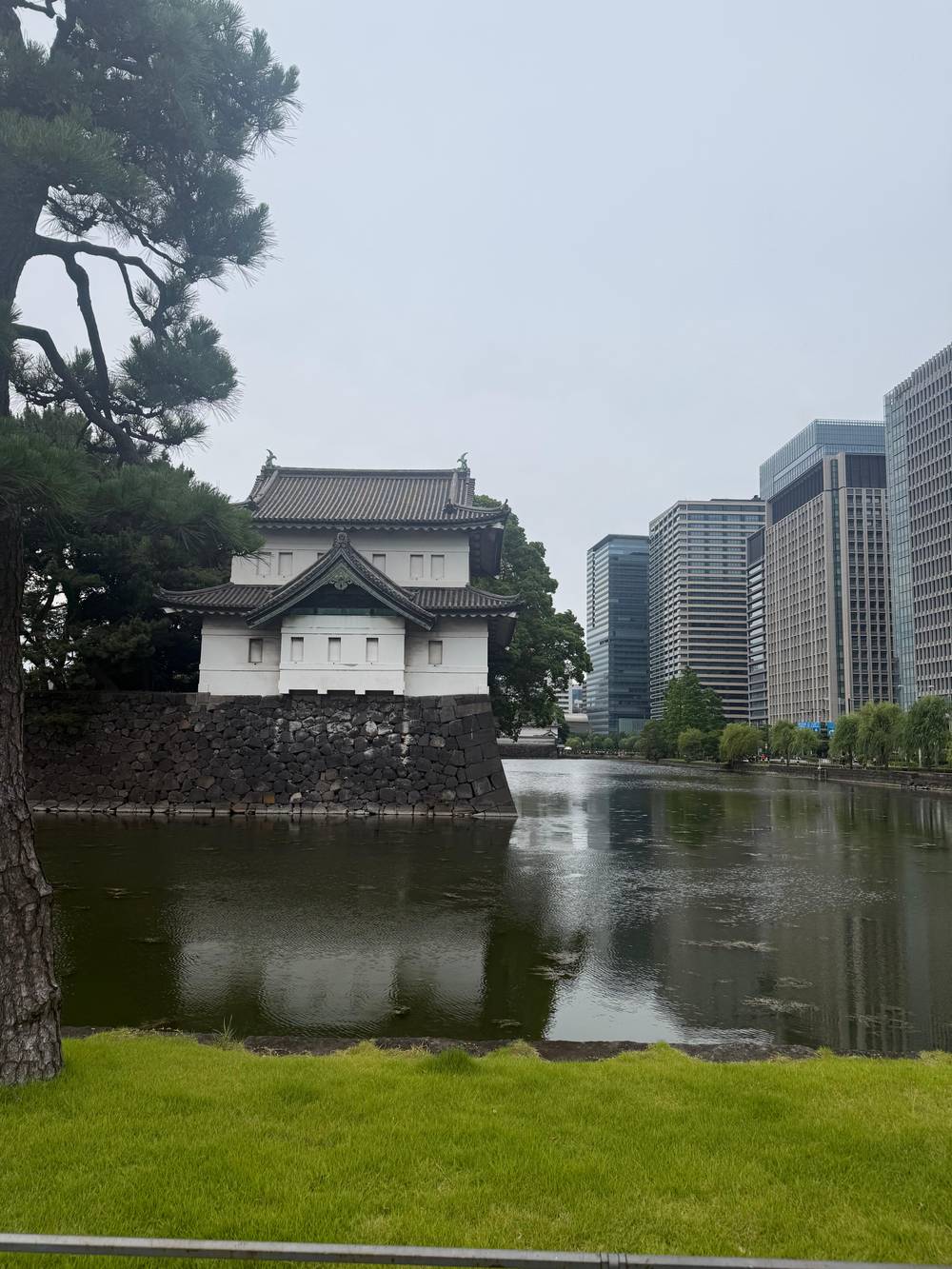
The plaza is dominated by trees. There are about 2,000 Japanese black pines in the plaza area in front of the Imperial Palace, and their sculptural forms are among the most photographed aspects of the garden.3
They are younger than the castle. The planting of the copse seen today began in 1888.21 The area itself was once an inlet of Edo Bay and was filled in during 1593 to expand the castle complex.22
Rows of trees known as Ochirindai stand between the Main Gate and the Sakashita-mon Gate.23 It is easy to treat the pines as scenery, but they are the product of constant pruning and are worth a slower look. Stand at the gravel edge and follow the lines of the crowns toward the moat, where the shapes repeat like a row of bonsai at a giant scale. Early morning gives the clearest air and the fewest people.
A bridge over time
From wood to iron
Edo period
Wooden double
A wooden bridge reinforced underneath by a second wooden bridge.8
1888
Iron bridge
It becomes an iron bridge in the Meiji period.9
1900
Statue
The Kusunoki statue is presented to the agency.10
1964
Repair
The bridge is repaired to reach its present look.9
Every January 2
Open day
The Main Gate opens to the public.11
The Kusunoki Masashige statue
Near the plaza stands a solid bronze statue of Kusunoki Masashige, who lived from 1294 to 1336 and is remembered for his commitment to the samurai code.24 The statue was made and presented to the Imperial Household Agency in 1900.10
It is pure bronze, which makes it extraordinarily heavy, and that probably helped it survive the Great Kanto Earthquake.25 The ministry describes a man awaiting the return of an exiled emperor, which gives the figure its watchful posture.
The statue is one of the features lit at night, along with the arches of Wadakurabashi Bridge, Sakuradamon Gate and the stone moat walls.14 Walk to it in the evening if you have time. The figure on horseback is easy to miss in daylight, and the lighting gives it a different, more theatrical presence against the dark moat. If you like a quiet corner for photographs, this is one.
Video
Imperial Palace Tokyo travel guide: best time, history and tips
Globe Travel Adventures on YouTube · Your tap on play is what loads the video.
The most popular portrayal of the Imperial Palace is this view of the Stone Bridge with the Main Gate on the left, the Iron Double Bridge behind it, and the Fushimi watchtower in the distance.
On the plaza
Photography and visit checklist
Photography3
Wadakura and the lights after dark
Wadakura Fountain Park was built in 1961 to mark the wedding of the Heisei Emperor Emeritus and renovated in 1995.16 The main fountain forms a chrysanthemum design, and Tatsumi Watchtower makes a backdrop for photos taken from the glass bridge.26,27
The garden's lighting runs on a simple rule. All year the lights go on 15 minutes after sunset and are turned off by 9 p.m.4 In spring and summer they are a soft white color, and in autumn and winter a warmer orange tone.28
At the NOAA Tokyo station used for this site, August has an average daily high of 31.1 °C and January 9.8 °C,29,29 so summer calls for a hat and winter for a coat. That makes the plaza a useful evening stop, quiet and well lit, between a day of sightseeing and dinner in Marunouchi, which is a short walk away. The colour change by season is a small detail worth noticing if you visit in both halves of the year, as the white of summer reads cooler than the orange of winter.
Getting there and plaza manners
The bridge area is a 2-minute walk from Sakuradamon Station and a 3-minute walk from Hibiya and Nijubashimae stations.5 Kokyo Gaien is also a 10-minute walk from JR Tokyo Station.13
A few rules apply on the plaza. Smoking, including e-cigarettes, is prohibited,19 and so are sports other than jogging and marathons, along with the use of play equipment.20 Treat the lawn and pines as a garden, not a sports ground. Keep to the paths and let the trees be the attraction, which suits a quiet walk and a slow photograph.
For a guide who can point out the bridges from the right angle, the Viator walking tour behind this site starts from $13, lasts 2 hours and allows up to 15 in a group. Use the sun tool above to pick a month and a light for your photograph. The plaza is open air with little shade, so a hat and water bottle are worth carrying in the warm months.
FAQ
Common questions, answered fast.
Which bridge is the Nijubashi?
The name does not cover the stone bridge in front.1
Can I walk across the Nijubashi?
The bridges are usually closed to the public.2
When is the Main Gate open?
The ministry states those two occasions.11
How many pine trees are there?
They stand on the plaza in front of the palace.3
When do the plaza lights go on?
They are turned off by 9 p.m.4
How do I reach the bridge?
It is 2 minutes from Sakuradamon Station.5
Is smoking allowed?
Smoking, including e-cigarettes, is prohibited.19
Sources
- Ministry of the Environment (Kokyo Gaien National Garden) · The Main Gate and the Nijubashi Double Bridge ↩
- Chiyoda City Tourism Association · Nijubashi Bridge ↩
- Ministry of the Environment (Kokyo Gaien National Garden) · Japanese Black Pine Trees ↩
- Ministry of the Environment (Kokyo Gaien National Garden) · Kokyo Gaien Illumination ↩
- Chiyoda City Tourism Association · Nijubashi Bridge ↩
- Chiyoda City Tourism Association · Nijubashi Bridge ↩
- Chiyoda City Tourism Association · Nijubashi Bridge ↩
- Ministry of the Environment (Kokyo Gaien National Garden) · The Main Gate and the Nijubashi Double Bridge ↩
- Chiyoda City Tourism Association · Nijubashi Bridge ↩
- Ministry of the Environment (Kokyo Gaien National Garden) · Statue of Kusunoki Masashige ↩
- Ministry of the Environment (Kokyo Gaien National Garden) · The Main Gate and the Nijubashi Double Bridge ↩
- Chiyoda City Tourism Association · Kokyo Gaien National Garden ↩
- Chiyoda City Tourism Association · Kokyo Gaien National Garden ↩
- Ministry of the Environment (Kokyo Gaien National Garden) · Kokyo Gaien Illumination ↩
- Ministry of the Environment (Kokyo Gaien National Garden) · Sakuradamon Gate ↩
- Ministry of the Environment (Kokyo Gaien National Garden) · Wadakura Fountain Park ↩
- Ministry of the Environment (Kokyo Gaien National Garden) · The Main Gate and the Nijubashi Double Bridge ↩
- Tokyo Convention & Visitors Bureau (GO TOKYO) · A guide to the Tokyo Imperial Palace: history & how to tour ↩
- Ministry of the Environment (Kokyo Gaien National Garden) · Kokyo Gaien National Garden ↩
- Ministry of the Environment (Kokyo Gaien National Garden) · Kokyo Gaien National Garden ↩
- Ministry of the Environment (Kokyo Gaien National Garden) · Japanese Black Pine Trees ↩
- Ministry of the Environment (Kokyo Gaien National Garden) · Japanese Black Pine Trees ↩
- Chiyoda City Tourism Association · Kokyo Gaien National Garden ↩
- Ministry of the Environment (Kokyo Gaien National Garden) · Statue of Kusunoki Masashige ↩
- Ministry of the Environment (Kokyo Gaien National Garden) · Statue of Kusunoki Masashige ↩
- Ministry of the Environment (Kokyo Gaien National Garden) · Wadakura Fountain Park ↩
- Ministry of the Environment (Kokyo Gaien National Garden) · Wadakura Fountain Park ↩
- Ministry of the Environment (Kokyo Gaien National Garden) · Kokyo Gaien Illumination ↩
- NOAA · Global Summary of the Month, Station Tokyo (NOAA GHCN JA000047662), 1971 to 2020 ↩
More to read