Help me decide
Tokyo Imperial Palace history and who lives there
The quick take
The Tokyo Imperial Palace has been the residential palace of the Emperors since 1868, and the Emperor and Empress have lived in the Fukiage Gardens inside its grounds since September 2021.
Dates and homes
Two taps to a walk
A palace walk for the story you want
Say who you want beside you and what you want to hear about, and a listing appears with its starting price.
Your ideal pick
A private walk through the old castle grounds
from $63
It is a private group tour and runs about 2 hours.
Your ideal pick
The shogun and castle-keep walk
from $13
Its listing mentions the keep foundation and stone gates; it runs about 2 hours.
Your ideal pick
The long East Gardens walk
from $20
It runs about 2.5 hours and stops at Ninomaru Garden.
Your ideal pick
The most-reviewed palace walk
from $13
Rated 4.95 from 3,368 reviews on Viator.
The palace on the old castle site has had several lives. This page follows it from the move of the court in 1868, through wartime loss and the 1968 rebuilding, to the question visitors ask most: who actually lives behind the moat?
Editorial team, tokyoimperialpalace.top · Updated November 6, 2026 · ~6 min read
Overview
- SinceThe site has been the residential palace of the successive Emperors since 1868.1
- Current palaceThe main building was completed in October 1968 and came into use in April of the following year.2
- Who lives hereIn September 2021 the Emperor and Empress moved to the Imperial Residence in the Fukiage Gardens inside the grounds.3
- Other family homesThe Emperor Emeritus and Empress Emerita have lived on the Akasaka Estate since April 2022.4
- Inside the palaceVisitors cannot go inside, except on rare special occasions.5
From shogun's castle to imperial palace
The story of the palace begins with a change of government. The former Edo castle, the seat of the shogunate, was turned into the Imperial Palace in 1868.6 The Emperor moved from Kyoto to Tokyo in 1869, after living in Kyoto for over a millennium.7
The name changed as well. The palace was officially called Kyujo, the palace castle, from 1888 to 1948, and has since been called simply Kokyo, the Imperial Palace.8 If you read older books or visit older museums, the word you meet may be the earlier one, and knowing both saves confusion. The change of title also marks how the palace was seen: first as a castle repurposed for a court, later as a plain imperial residence.
Behind the words is a continuity worth noticing. The Imperial Palace has served as the residential palace of the successive Emperors since 1868,1 so the site holds almost the whole span of the modern imperial era, on ground that the shoguns built up for their own purposes.
Who is where
Imperial residences named by the agency
| Residence | Place | Since | Note |
|---|---|---|---|
| Imperial Residence | Fukiage Gardens, palace grounds | September 20213 | Emperor and Empress3 |
| Emperor Emeritus residence | Akasaka Estate, Minato ward | April 20224 | Emperor Emeritus and Empress Emerita4 |
| Prince Akishino residence | Akasaka Estate, Minato ward | Redesigned residence | On the same estate14 |
| Fukiage Omiya Palace | Palace grounds | Former residence | Emperor Showa and Empress Kojun12 |
What stands inside the grounds
The grounds are not a single building but a small district. The Imperial Household Agency says they contain the Fukiage Omiya Palace, the palace where various functions are conducted, the agency buildings, the Momijiyama Imperial Cocoonery, the Imperial Concert Hall and the East Gardens.10
Some of these have long histories of their own. The Palace Sericulture Centre is where the successive Empresses have raised silkworms.11 The Fukiage Omiya Palace was the living quarter of Emperor Showa and Empress Kojun, in the Fukiage area of the grounds.12
Of all of it, the East Gardens are the part anyone can enter. They were completed in September 1968 and have been open to the public since 1 October of that year, except when used for court functions.13 The rest of the complex is kept private or opened only for set events, which is why a clear picture of the layout helps before you arrive. Think of the East Gardens as the public front room of a much larger house.
A palace over time
Key dates of the palace
1868
Court arrives
The former Edo castle becomes the Imperial Palace.6
1869
Emperor moves
The Emperor moves from Kyoto to Tokyo.7
1888
Kyujo
The name Kyujo applies until 1948.8
1949
Plaza opens
A part of the old gardens becomes a National Garden.9
1968
New palace
The main building is completed in October.2
2021
Move to Fukiage
The Emperor and Empress take up residence in the Fukiage Gardens.3
The palace of 1968
The palace you see in photographs is a postwar building. The main building was completed in October 1968 and came into use in April of the following year.2 The agency describes a steel-reinforced concrete structure of two stories with an underground floor and an inclined roof with long eaves.17
It is made of a main building and a set of wings. The Seiden, the Main Building, is joined by six wings.18 Together they host the ceremonies of state: the New Year greeting, investitures, the presentation of credentials, decorations, luncheons, dinners and audiences.19
From the plaza you see little of this, because the palace buildings are hidden behind trees beside the Nijubashi.20 That distance is part of the experience, and explains why people so often ask whether it is possible to go in. The honest answer is on this page: the main building stays closed, but the surroundings repay a slow visit.
War and rebuilding
The palace did not survive the Second World War. GO TOKYO says it was destroyed during the war and rebuilt in a similar style afterward.22 The present building is therefore a successor and not a survivor, and the date of its completion is given by the agency in the next section.2 Some visitors arrive expecting the shogun's halls and find a modern structure instead.
The postwar settlement also changed ownership. Under the Constitution, which came into force in 1947, the lands and other properties formerly held by the Imperial House were handed over to the State, and some were assigned to the use of the Imperial House.23
Public access grew from that point. A portion of the former imperial gardens has been open to the public as a National Garden since 1949,9 and Kitanomaru was opened as a park in 1969 to commemorate the 60th birthday of the Showa Emperor.24
Price a guided visit
What a guided palace walk costs for your group
Choose how many people are coming and compare three listings
Compare all 3 options
What a guided palace walk costs for your group
Choose how many people are coming and compare three listings
- Shogun walking tour2 hours, small group · per individual from $13
≈
View - East Gardens walk2.5 hours · per individual from $20
≈
View - Private tour2 hours, private · from $63 up
≈
View
From-prices on GetYourGuide, shown at the ECB reference rate. Your exact price is confirmed during booking.
Who lives where today
The question of the palace's residents has a precise answer from the agency. In September 2021 the Emperor and Empress moved from the Akasaka Estate, where they had lived for many years, to the Imperial Residence within the Fukiage Gardens in the Imperial Palace grounds.3 They also hold official events at that residence, in addition to the palace.
The rest of the family lives elsewhere. The Emperor Emeritus and Empress Emerita have lived in a residence on the Akasaka Estate in Minato ward since April 2022.4 Prince Akishino's residence is also on the Akasaka Estate.14
So the palace behind the moat is both a working center and a home. The agency lists the present Emperor as the 126th Emperor.25 You will not see any of it from the public paths, but knowing where people live helps when you read the signs and understand why some gates are closed to everyone on ordinary days.
Video
What is really behind the walls of Tokyo's Imperial Palace
s34n Travels on YouTube · Your tap on play is what loads the video.
On special days, such as New Year’s and the Emperor’s birthday, the public is allowed to visit the palace and congratulate the Emperor.
Visit well
Before you try to see the palace
Realistic expectations3
When the public is let in
There are days when the palace opens its doors to the people. On special days, such as New Year's and the Emperor's birthday, the public is allowed to visit the palace and congratulate the Emperor.16 Our page on special openings covers the times and the gates.
Another route is the agency's palace tour, which is a different thing from entering the building. GO TOKYO notes that you cannot go inside, except on rare special occasions that let you glimpse the interior.5 Even so, the tour walks past historic sites and across the famous Nijubashi, which is considered a symbol of the palace and of Tokyo itself.15
For everyone else the grounds are best enjoyed from outside the moat and through the East Gardens, with the history of the site in your head. Bring that history with you: it turns a calm lawn into a layered place, where the shogun's court and the modern imperial household occupy the same ground.
A site you can read from the ground
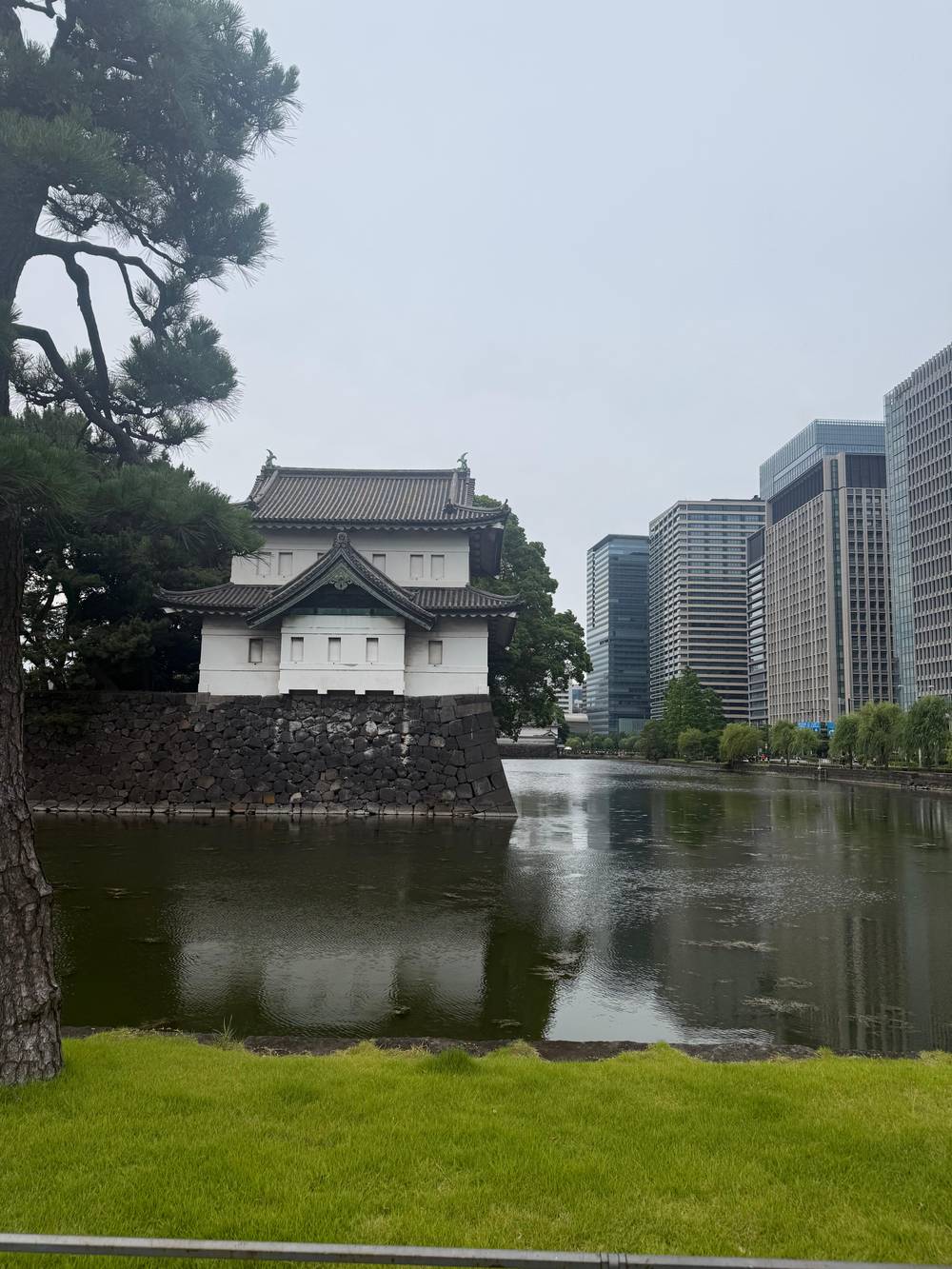
Each period leaves a trace you can find. The Tenshudai base belongs to the castle,26 the Fujimi-yagura to the age after the 1657 fire,27 the Wadakura fountain park to the wedding of the Heisei Emperor Emeritus in 1961,28 and the palace itself to 1968.2
The whole area covers about 1.15 square kilometers in central Chiyoda Ward, according to GO TOKYO.21 That scale is a good argument for a plan: the moat, the plaza, the gardens and the palace tour make up several short visits rather than one large one.
A walking tour from this site's own listing, which lasts 2 hours and starts from $13, covers the palace-side stones and the keep foundation in a single morning.
FAQ
Common questions, answered fast.
Does the Emperor live in the Imperial Palace?
Since September 2021 the Emperor and Empress live at the Imperial Residence there.3
When did the palace become the imperial residence?
The former Edo castle became the Imperial Palace that year.6
When was the current palace built?
It came into use in April of the following year.2
Where does the Emperor Emeritus live?
The residence is on the Akasaka Estate in Minato ward, in use since April 2022.4
Can you go inside the palace?
Only on rare special occasions can visitors glimpse the interior.5
Was the palace damaged in the war?
It was rebuilt in a similar style afterward.22
What was the palace called before?
It carried that name from 1888 to 1948.8
Sources
- Imperial Household Agency · Facilities and Visit Guidelines (Imperial Household Agency Visit Guide) ↩
- Imperial Household Agency · The Imperial Palace ↩
- Imperial Household Agency · Their Majesties the Emperor, Empress and Princess Aiko ↩
- Imperial Household Agency · Other Imperial Residences ↩
- Tokyo Convention & Visitors Bureau (GO TOKYO) · A guide to the Tokyo Imperial Palace: history & how to tour ↩
- Imperial Household Agency · The Imperial Palace ↩
- Ministry of the Environment (Kokyo Gaien National Garden) · Former Edo Castle ↩
- Imperial Household Agency · The Imperial Palace ↩
- Chiyoda City Tourism Association · Kokyo Gaien National Garden ↩
- Imperial Household Agency · The Imperial Palace ↩
- Imperial Household Agency · Facilities and Visit Guidelines (Imperial Household Agency Visit Guide) ↩
- Imperial Household Agency · Fukiage Omiya Palace ↩
- Imperial Household Agency · The Imperial Palace ↩
- Imperial Household Agency · Other Imperial Residences ↩
- Tokyo Convention & Visitors Bureau (GO TOKYO) · A guide to the Tokyo Imperial Palace: history & how to tour ↩
- Imperial Household Agency · The Imperial Palace (Kids page) ↩
- Imperial Household Agency · The Imperial Palace ↩
- Imperial Household Agency · The Imperial Palace ↩
- Imperial Household Agency · FAQ ↩
- Ministry of the Environment (Kokyo Gaien National Garden) · The Main Gate and the Nijubashi Double Bridge ↩
- Tokyo Convention & Visitors Bureau (GO TOKYO) · A guide to the Tokyo Imperial Palace: history & how to tour ↩
- Tokyo Convention & Visitors Bureau (GO TOKYO) · A guide to the Tokyo Imperial Palace: history & how to tour ↩
- Imperial Household Agency · The Imperial Palace ↩
- Ministry of the Environment (Kokyo Gaien National Garden) · Kitanomaru Garden ↩
- Imperial Household Agency · FAQ ↩
- Chiyoda City Tourism Association · The East Gardens of the Imperial Palace ↩
- Chiyoda City Tourism Association · The East Gardens of the Imperial Palace ↩
- Ministry of the Environment (Kokyo Gaien National Garden) · Wadakura Fountain Park ↩
More to read