Dynamic chart
Cherry blossoms at the Tokyo Imperial Palace
The quick take
Cherry blossoms around the Tokyo Imperial Palace tend to start in the last few days of March and reach full bloom in the first week of April, with the Chidorigafuchi moat the best-known spot.
Bloom and trees
Blossom against the calendar
Twelve months around the palace moat
Choose a month to compare sunset, day length and the usual warmth, plus what the moat and gardens offer then.
Sunset
Jan
Feb
- Sun sets around 17:21
- Sun is up about 10.9 h16
- What the month holds: Early cherries in the gardens5
- Days hover near 10°C, nights hover near 2°C16
The agency's flower calendar lists early cherries from early February to early March.5
Mar
- Sun sets around 17:48
- Sun is up about 11.9 h16
- What the month holds: Flowering starts late in the month5
- Days hover near 13°C, nights hover near 5°C16
Flowering tends to begin in the last few days of March.1
Apr
- Sun sets around 18:13
- Sun is up about 13.1 h16
- What the month holds: Full bloom, then petals5
- Days hover near 19°C, nights hover near 10°C16
Full bloom comes in the first week of April, and the greenway is lit for about 12 days from late March.1,10
May
Jun
Jul
Aug
Sep
Oct
Nov
- Sun sets around 16:35
- Sun is up about 10.3 h16
- What the month holds: Rowboats until the month ends5
- Days hover near 17°C, nights hover near 9°C16
Rowboat rental runs from March through November.4
Dec
Sunset is worked out for the 15th of each month on Japan time. Day length and temperatures: NOAA averages for the Tokyo station used for this site, 1971 to 2020.
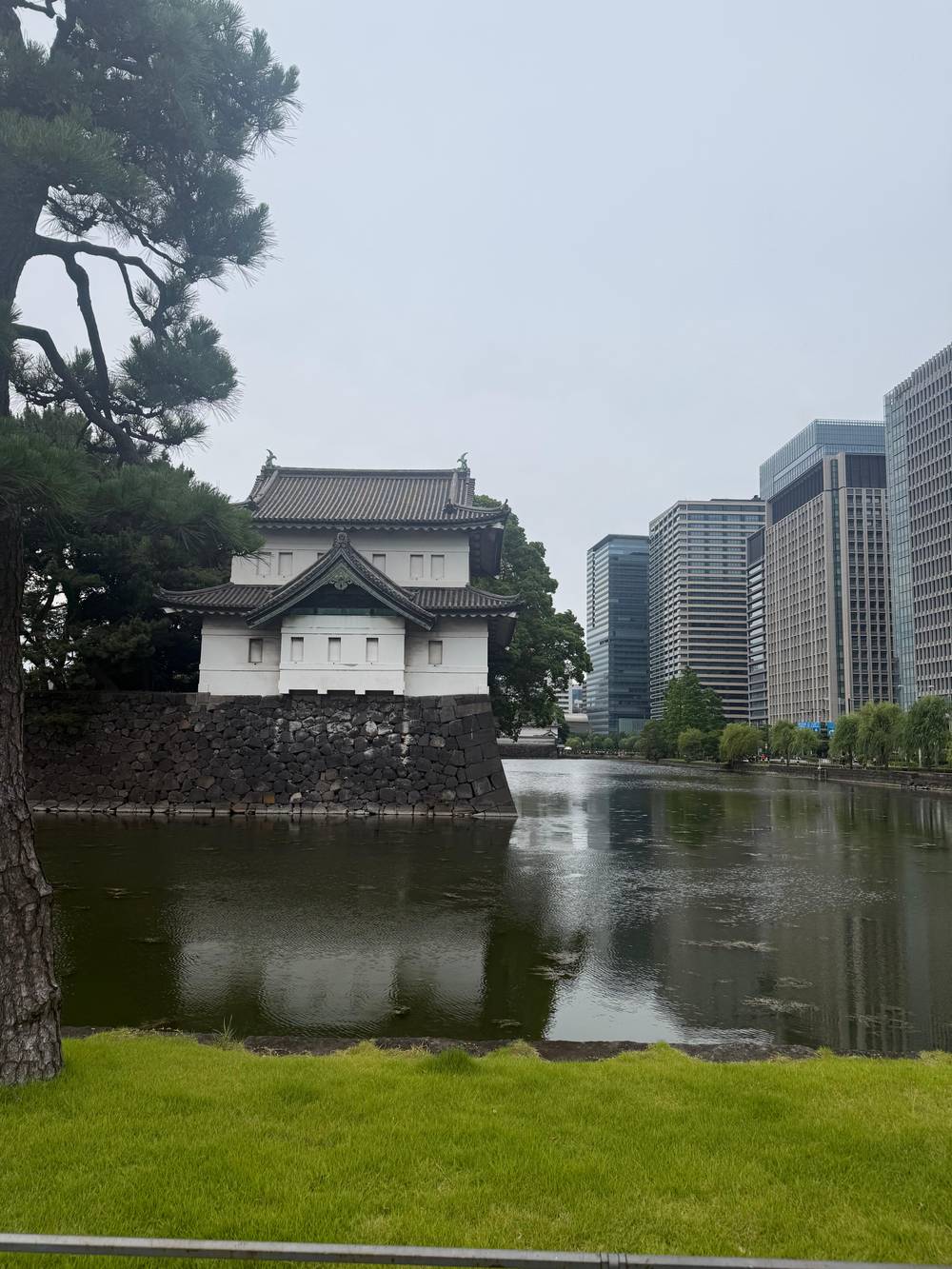
The palace is ringed by water and old trees, and in spring the moats turn pink. Here is when the trees open, where the best-known display stands, what the boats and lights add and how the East Gardens fit in.
Editorial team, tokyoimperialpalace.top · Updated November 6, 2026 · ~6 min read
Overview
- Bloom windowIn Tokyo the first flowers usually open in the closing days of March, and the peak follows in the first week of April.1
- Staying powerThe trees generally bloom for just a week or two.2
- Best-known spotAbout 140 cherry trees line the 700-meter Chidorigafuchi greenway.3
- On the waterRowboat rental is available from March through November.4
- GardensThe agency puts cherry trees in the East Gardens at mid-March to early April.5
When the trees open around the palace
The blossom season is short and shifts a little every year. In Tokyo and Yokohama the first flowers usually open in the closing days of March, and the peak follows in the first week of April.1 After that the petals hold for only a week or two.2
Forecasts add some precision but not certainty. The Japan Meteorological Agency defines full bloom as the day when over 80% of the flowers on a reference tree are open,6 and warns that its predicted dates can be off by two to three days either way.7
For the palace area, GO TOKYO places the pastel pink views at Chidorigafuchi between late March and early April.8 Plan a window of a few days around the date you hear in the news rather than a fixed day, and keep a flexible schedule. A trip built around one booked afternoon is a gamble, whereas a trip with several free mornings can adapt when the buds are early or late. If the blossom has not opened, the East Gardens and the museums nearby keep the days full.
Where to look
Blossom spots around the palace
| Spot | Trees | Extra | Nearest station |
|---|---|---|---|
| Chidorigafuchi greenway | About 1403 | Rowboats, night lights4 | Kudanshita, 5 minutes15 |
| Chidori-ga-fuchi Park | About 17017 | Rapeseed in bloom18 | Kudanshita side |
| Kitanomaru Garden | About 23019 | Pond and wildlife20 | Near the Budokan |
| East Gardens | Several groups5 | Free admission21 | Otemachi, 5 minutes22 |
Tree counts as given by the Chiyoda City Tourism Association; counts differ by what each source includes.17,3
The Chidorigafuchi greenway
Chidorigafuchi is the name most people give to the palace blossom, and the moat deserves it. About 140 cherry trees line the 700-meter greenway beside the moat, which creates a tunnel of blooms in early spring.3 Somei-Yoshino is the most abundant variety.12
The moat is named for the plover, chidori, whose shape it resembles.13 It is also tied to the castle's founding, since this natural moat played a role in the decision to build Edo Castle in the location.14
The nearest station is Kudanshita, a 5-minute walk from exit 2.15 Walk the greenway slowly and look for the moat reflections, which are a major part of the appeal. The path hugs the water, so the branches arch overhead and the petals settle on the surface in the final days. Walk it in both directions if you can, since the light changes the colour of the blossom.
Rowboats on the moat
For a different angle, rent a rowboat. Rowboat rental at Chidorigafuchi is available from March through November.4 On the water the trees reach down to the surface and the walkway above becomes a frame. Seen from a boat, the blossom is a ceiling rather than a wall, and the stone embankment that once defended the castle is clearly visible. Allow time for the dock queue in peak weeks and bring a camera strap, because hands are busy rowing.
The boat pier extends its hours for the blossom nights. The city's Sakura Festival page says the pier stays open until nighttime while the trees are lit for about 12 days from late March to early April every year.10
GO TOKYO notes that in the evening the trees are illuminated for after-dark strolls and rowboat rides.24 Check the Chiyoda City Tourism Association page for the days and hours of the boats in the year you travel, since the season is short and the schedule is set for it.
Choose your blossom day
Which blossom plan suits you?
Find the row that matches how you like to see spring
If I want the famous tunnel of blossom
Walk the Chidorigafuchi greenway
About 140 trees line 700 meters.3
If I want to see it from the water
Rent a rowboat
Rentals run from March through November.4
If I want it after dark
Come for the lights
The greenway is lit for about 12 days.10
If I want fewer crowds
Go early in the day
The tourism organization advises it.23
If I want blossom and history
Walk the East Gardens
Admission is free and cherry trees bloom mid-March to early April.21,5
Lights and the Sakura Festival
The Chiyoda City Sakura Festival is a collective of events during the blossom weeks. In the 2026 edition it ran from March 5 to April 22,30 and the illumination ran from March 26 to April 6.31 The festival organisers fix the dates each year, so do not copy those numbers into a plan without checking.
The lights are a main attraction. The nighttime cherry blossoms along the greenway are lit for about 12 days from late March to early April.10 Expect crowds, queues and traffic restrictions near the greenway. Walking in slowly moving lines is part of the evening, and the lights are best enjoyed without rushing to the exit. Go with a plan for dinner afterwards in Marunouchi or Ginza, both a short train ride away.
Respect the rules on the greenway. Smoking and picnicking are prohibited,25 tripods and similar equipment should not be used,26 visitors are asked not to touch the trees,28 not to walk on the roadway29 and not to fly drones without authorization.27
A blossom spring
From first buds to the last petals
Early February
Early cherries
The calendar's first group peaks from early February to early March.9
Last days of March
Flowering starts
The first flowers open in Tokyo.1
Late March
Lights begin
The greenway is lit for about 12 days.10
First week of April
Full bloom
The main group peaks.1
A week or two
Petals fall
The petals hold for only that long.2
Mid-April
Late cherries
The calendar's later group peaks until late April.11
Chidori-ga-fuchi Park and Kitanomaru
Beside the greenway is Chidori-ga-fuchi Park, which opened in 1919 and is about 450 meters long north to south.32 About 170 cherry trees, including Somei Yoshino and Yamazakura, are planted in it.17 From February to May rapeseed also blooms yellow beside the pink.18
A short stroll on is the Kitanomaru Garden, which holds about another 230 cherry trees including Somei Yoshino.19 The Ministry of the Environment calls Kitanomaru particularly beautiful in the cherry blossom season and again in autumn.33
Kitanomaru also has its own wooded areas and a pond that serve as a home for local wildlife.20 It is a calmer option for people who find the greenway too busy, with open lawns for a rest between viewings. Pair it with the Budokan or the museums if rain arrives.
Video
Chidorigafuchi in Tokyo: a sakura viewing spot
Japan travel guide on YouTube · Your tap on play is what loads the video.
visit Chidori-ga-fuchi Moat between late March and early April for pastel pink views
Blossom week kit
What to remember
Timing3
Blossom inside the East Gardens
Inside the palace grounds the East Gardens carry cherries too. The agency's flower calendar lists cherry trees with a good time to see them from early February to early March, again from mid-March to early April, and a later group from mid-April to late April.9,5,11
Hours change at the turn of the season. Between March 1 and April 14 the gardens stay open from 9:00 until 17:00, admitting people until 16:30,34 and from April 15 the day stretches to 18:00.35 The gardens close every Monday and Friday.36
The agency opens Inui Street each spring, which sends visitors past the trees on the western side of the grounds. Our special openings page has the rules.37
Weather, crowds and planning
Spring weather is changeable. The NOAA Tokyo station behind this site shows March afternoons at 13.3 °C on average and nights at 4.7 °C,16 while April climbs to 18.8 °C by day and 10.2 °C by night.16 Bring a warm layer for an evening beside the moat, and a light rain jacket in case a shower arrives. The temperature drop after sunset is noticeable beside the water, so a scarf is a sensible addition.
For fewer people, the Japan National Tourism Organization advises going early in the day.23 Yasukuni Shrine, nearby, also holds a yearly cherry blossom festival with food stalls and evening illuminations.38
A guided walk combines the blossom with the history. The Viator walking tour for this site takes 2 hours and is priced from $13, and a spring walk gives you the castle stones and the pink moat in one outing. Book early in blossom week and choose a morning slot, which leaves your afternoon free for the greenway.
FAQ
Common questions, answered fast.
When do the cherry blossoms bloom at the palace?
The first flowers usually open in Tokyo in the closing days of March.1
How long do they last?
The trees generally bloom for just a week or two.2
How many trees are at Chidorigafuchi?
They line a 700-meter greenway.3
Can I rent a rowboat?
GO TOKYO states the rental period.4
Are the trees lit at night?
The lighting runs from late March to early April.10
Can I picnic along the greenway?
Smoking and picnicking are prohibited.25
Which station is best for the moat?
The walk is 5 minutes from exit 2.15
Are the East Gardens good for blossom?
The calendar lists cherry trees from mid-March to early April.5
Sources
- Tokyo Convention & Visitors Bureau (GO TOKYO) · Sakura - where, when, and how to enjoy Japanese cherry blossoms ↩
- Tokyo Convention & Visitors Bureau (GO TOKYO) · Sakura - where, when, and how to enjoy Japanese cherry blossoms ↩
- Ministry of the Environment (Kokyo Gaien National Garden) · Chidorigafuchi Moat ↩
- Tokyo Convention & Visitors Bureau (GO TOKYO) · Chidori-ga-fuchi Moat ↩
- Imperial Household Agency · Flower Calendar ↩
- Japan Meteorological Agency · Forecast of cherry blossom blooming dates ↩
- Japan Meteorological Agency · Forecast of cherry blossom blooming dates ↩
- Tokyo Convention & Visitors Bureau (GO TOKYO) · Chidori-ga-fuchi Moat ↩
- Imperial Household Agency · Flower Calendar ↩
- Chiyoda City Tourism Association (Visit Chiyoda) · Chiyoda City Sakura Festival ↩
- Imperial Household Agency · Flower Calendar ↩
- Ministry of the Environment (Kokyo Gaien National Garden) · Chidorigafuchi Moat ↩
- Ministry of the Environment (Kokyo Gaien National Garden) · Chidorigafuchi Moat ↩
- Ministry of the Environment (Kokyo Gaien National Garden) · Chidorigafuchi Moat ↩
- Tokyo Convention & Visitors Bureau (GO TOKYO) · Chidori-ga-fuchi Moat ↩
- NOAA · Global Summary of the Month, Station Tokyo (NOAA GHCN JA000047662), 1971 to 2020 ↩
- Chiyoda City Tourism Association · Chidori-ga-fuchi Park ↩
- Chiyoda City Tourism Association · Chidori-ga-fuchi Park ↩
- Chiyoda City Tourism Association · Chidori-ga-fuchi Park ↩
- Ministry of the Environment (Kokyo Gaien National Garden) · Kitanomaru Garden ↩
- Imperial Household Agency · The East Gardens of the Imperial Palace in Tokyo ↩
- Chiyoda City Tourism Association · The East Gardens of the Imperial Palace ↩
- Japan National Tourism Organization · Imperial Palace & Tokyo Station ↩
- Tokyo Convention & Visitors Bureau (GO TOKYO) · Chidori-ga-fuchi Moat ↩
- Chiyoda City Tourism Association (Visit Chiyoda) · Chiyoda City Sakura Festival ↩
- Chiyoda City Tourism Association (Visit Chiyoda) · Chiyoda City Sakura Festival ↩
- Chiyoda City Tourism Association (Visit Chiyoda) · Chiyoda City Sakura Festival ↩
- Chiyoda City Tourism Association (Visit Chiyoda) · Chiyoda City Sakura Festival ↩
- Chiyoda City Tourism Association (Visit Chiyoda) · Chiyoda City Sakura Festival ↩
- Chiyoda City Tourism Association (Visit Chiyoda) · Chiyoda City Sakura Festival ↩
- Chiyoda City Tourism Association (Visit Chiyoda) · Chiyoda City Sakura Festival ↩
- Chiyoda City Tourism Association · Chidori-ga-fuchi Park ↩
- Ministry of the Environment (Kokyo Gaien National Garden) · Kitanomaru Garden ↩
- Imperial Household Agency · The East Gardens of the Imperial Palace in Tokyo ↩
- Imperial Household Agency · The East Gardens of the Imperial Palace in Tokyo ↩
- Imperial Household Agency · The East Gardens of the Imperial Palace in Tokyo ↩
- Imperial Household Agency · Others (East Gardens, Inui Street, special tours) ↩
- Japan National Tourism Organization · Imperial Palace & Tokyo Station ↩
More to read